Lovable, Cursor, Bolt, v0, Replit, Claude Code. You shipped fast. Now real users hit your app and things break. Our engineers fix the auth holes, secure the data, refactor the spaghetti, and take your prototype to production grade. The systems we have built drive over thirty million dollars in identified savings and incremental revenue for our clients, in measurable defensible numbers.
Risk Brief is 100% credited toward any engagement above $25k. If we do not surface at least one issue worth 10x its price, we refund it.
40+
Vibe-coded apps rescued
600+
Security findings closed
9 days
Avg. time to production
own-the-climb · vibe-audit
AC
Written by the Own The Climb engineering team
Led by Alex Carroll, Founder & CEO · Maryland, USA · About the team
"Every example on this page comes from a real client engagement. The patterns are what we saw, not what we guessed."
Engagements start at $5,000. Most rescues land between $75k and $400k.
Last updated
Definition
What Is Vibe Coding?
Vibe coding is building software by describing what you want in plain English and letting an AI write the code for you. The term was coined by Andrej Karpathy in February 2025 to describe a new way of programming where you focus on intent and outcomes, not syntax. Tools like Lovable, Cursor, Bolt, v0, Claude Code, and Replit Agent let founders, marketers, operators, and small teams ship real working apps in hours instead of months.
It is the most important shift in software since the App Store. It is also where most projects quietly fall apart, because shipping a working screen and running a real business on that screen are two very different things.
What it is great at
MVPs, internal tools, landing pages, prototypes, marketing pages, dashboards, and any project where speed beats perfection.
Where it gets dangerous
Auth, payments, customer data, file uploads, third-party API keys, multi-user permissions, and anything that touches money or PII.
What we do
We audit, harden, refactor, and finish vibe-coded apps so they survive real customers, real load, real attackers, and real growth.
60-Second Risk Check
Is your vibe-coded app at risk?
Five questions. Be honest. We see every one of these missed on most vibe-coded apps we audit.
01.Are any API keys, tokens, or secrets visible in the browser bundle?
Open DevTools → Sources, search for "sk_", "service_role", or your AI provider name.
02.Does your database have row-level security on every table with user data?
No RLS = one curl returns everything.
03.Is auth enforced on the server, not just the client?
A hidden route is not an auth model.
04.Do you have error monitoring on the production app today?
Sentry, Highlight, or anything that pages you when things break.
05.Is there at least one test on the signup, login, or checkout path?
CI that runs on every merge counts.
Answer 0 / 5
The Vibe Coding Wall
Ten things that break the day a real user shows up
Every one of these is something we have fixed on a vibe-coded app this year. Click any card to see how we fix it.
From our 2026 internal audits
0%
Apps with at least one exposed secret
0%
Supabase apps missing or misconfigured RLS
0%
Apps with no production error monitoring
0%
Apps without a single test on a money path
Source: Own The Climb internal audit observations across 40+ vibe-coded apps, 2026.
A repeatable five-step process. We have run it dozens of times. It works.
01
Audit
We read the entire codebase, the database, and the deploy. You get a written report with every security, performance, and architecture issue, ranked by risk.
02
Stabilize
We patch the bleeding first. Exposed keys rotated. Auth holes closed. Database access locked down. Error monitoring turned on. Within days, not weeks.
03
Refactor
We pull duplicated logic into one place, split monster components, add types where they were missing, and make the codebase something a real team can extend.
04
Harden
Tests on the money paths. CI that blocks broken builds. Rate limits, input validation, RLS audits, dependency scanning, and the security posture investors and enterprise buyers expect.
05
Scale
Performance work, SEO and AI search optimization, observability, and the engineering retainer that keeps your app shipping new features without going back into the same hole.
Rescue Stories
Real clients. Real fixes. Real numbers.
Five vibe-coded apps we rescued, rebuilt, or replaced. Names used with permission. Numbers shared with permission.
in verified client savings, identified by the portal we built
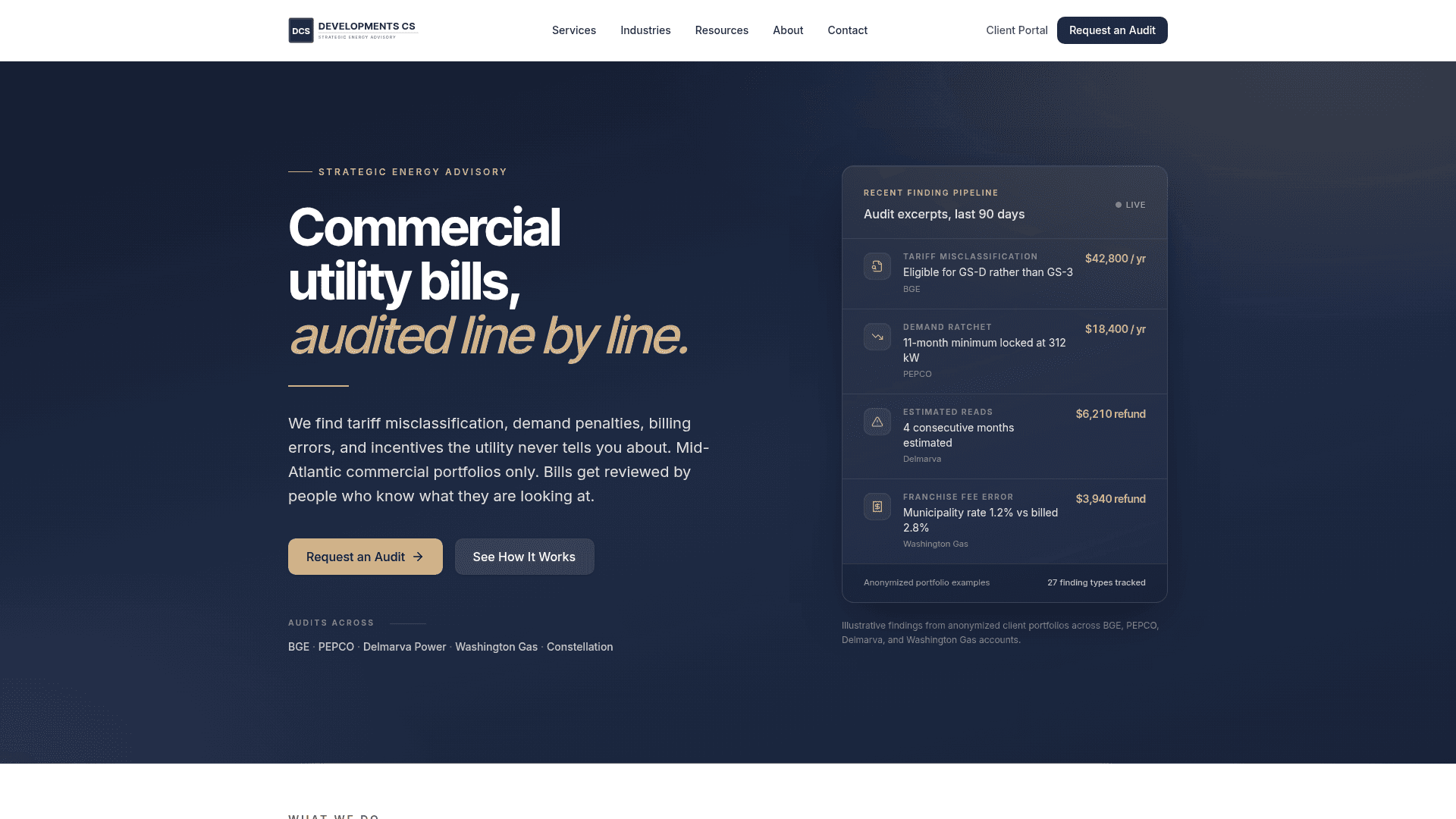
We built them a utility intelligence portal that has now identified over seventeen million dollars in verified savings for their clients, on top of the time recovered, the sourcing efficiency, and the data infrastructure we delivered alongside it. We also rebuilt their marketing site and lead funnel, lifting conversion meaningfully across their primary keywords. What they have now is a system their analysts trust and their clients pay for. The portal pays for itself many times over inside a single engagement.
A system their analysts trust and their clients pay for. The portal pays for itself many times over inside a single engagement.
Stack: Utility intelligence portal + marketing site
https://developmentscs.com
SR
Sterling Realty Group
Real estate operator · NY, NJ, DC · hundreds of buildings
Featured Rescue
$0M+
in measurable savings across deal, leasing, marketing, and operations (6 months)
A privately held real estate company operating hundreds of buildings across New York, New Jersey, and Washington DC, plus parking garages and self storage. They came to us six months ago running deal diligence, leasing, marketing, and tenant operations across three states on fragmented tools and manual workflows. We built them an integrated operations platform: deal diligence intelligence, lease-up analytics, marketing and lead pipelines, and a full ERP and CRM unifying it all. The result in the first six months is over ten million dollars in measurable savings across deal diligence, leasing yield, marketing efficiency, and operational time recovered.
Over ten million dollars in measurable savings in six months, across deal diligence, leasing, marketing, and operations.
Stack: Integrated operations platform (built by us)
Private engagement
Internal tooling
Screenshot withheld at client request. Numbers shared with permission.
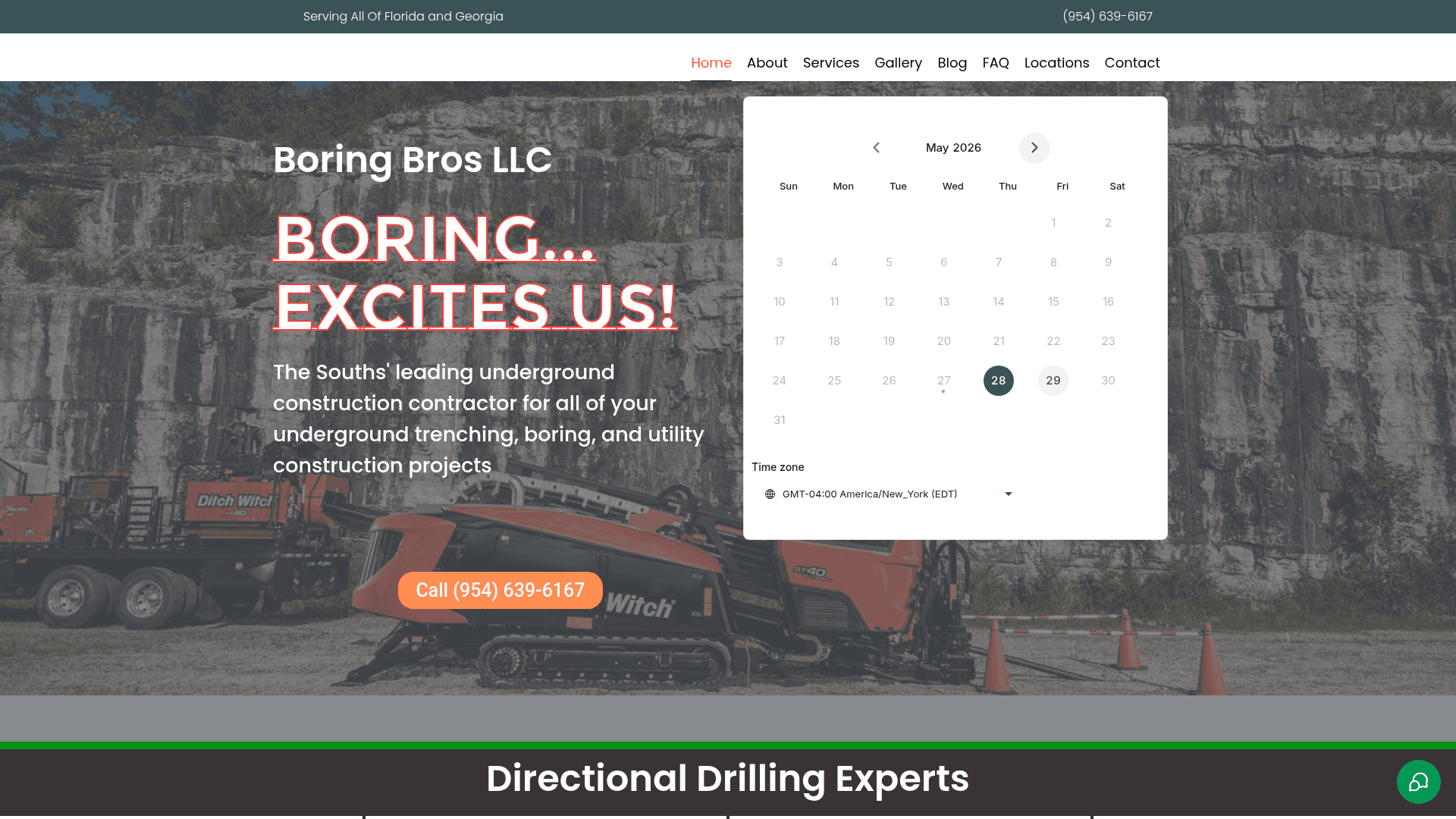
Boring Bro needed an ERP that did not yet exist on the market: a custom agentic system that could orchestrate quoting, scheduling, customer comms, and crew dispatch end to end. Off-the-shelf tools failed them. Vibe-coded prototypes failed them. They needed real engineering.
What we did
We designed and built a production-grade agentic ERP from the ground up. AI agents for quoting and customer triage, a hardened database with RLS and audit trails, real CI, monitoring, and an interface the whole team could run their day from. Then we kept improving it.
A category-defining tool inside their industry that drives over five million dollars in incremental revenue, year after year.
Stack: Custom agentic ERP (built by us)
https://boringbro.com
BT
Black Tie Funding
Financial services
Featured Rescue
$0+
saved and earned across the platform
The problem
Several internal vibe-coded tools sat at the heart of their sales operation. The platform was slow, lead scoring was inconsistent, deals fell through routing cracks, and the team did not trust the dashboard enough to act on it.
What we did
Re-architected the data layer, rebuilt lead scoring into a clean server-side pipeline, hardened the dashboard with real-time validation, added the integrations the sales team had been begging for, and instrumented every conversion step.
A platform the sales team finally trusted, and over a million dollars in saved cost and earned revenue.
Stack: Vibe-coded internal sales platform
Private engagement
Internal tooling
Screenshot withheld at client request. Numbers shared with permission.
RC
RenoSafe Construction
Construction · Baltimore, MD
Featured Rescue
0 lines removed
same features, faster, safer, compliant
200k → 134.8k
Lines of code in production
47
Critical vulnerabilities closed
3×
Faster load on field devices
100%
Tables now under row-level security
The problem
A construction firm in Baltimore vibe-coded an internal ERP that ballooned to over 200,000 lines of duplicated, hallucinated, and dead code. The build crashed nightly. Dozens of critical security vulnerabilities sat in the open. Field crews could not load the app reliably on a job site. Every new feature broke two existing ones.
What we did
Full audit, dead-code removal, type-safety pass, and a hard refactor that collapsed duplicated logic into shared modules. Patched every critical CVE. Closed the auth holes, added RLS across every table, separated roles into a dedicated role table, and stood up CI with security scanning on every merge.
Same product, two-thirds the code, dozens of security holes closed, and a field app that crews actually trust on the job.
Stack: Vibe-coded ERP, 200k+ lines
Private engagement
Internal tooling
Screenshot withheld at client request. Numbers shared with permission.
Lovable apps usually ship with clean components and a working Supabase backend. The most common rescue work is tightening RLS policies that were generated too permissive, moving any API key out of the client and into an edge function, and adding tests around the money paths. The codebase itself is usually in good shape, so rescues are often shorter than other stacks.
Cursor and Claude Code projects look like real codebases because they are. The rescue pattern here is architectural: duplicated logic across files, inconsistent state management, type-safety gaps the AI papered over, and dependencies it imagined into existence. We refactor for clarity, install the missing types, and align the project to the conventions of the framework it picked.
Bolt and v0 produce beautiful UI fast, but the backend story is often glued together after the fact. The most common rescue is replacing a fragile client-only data layer with a real server-side API, wiring up persistent storage, and adding auth where there was none. Once the foundation is real, the UI quality these tools start with shines.
Replit Agent projects come with hosting baked in, which is great for prototypes and a problem in production. We move the database to a real provider, lift secrets out of the env file pattern Replit defaults to, and stand up a proper CI and deploy pipeline so the next deploy does not depend on a single browser tab being open.
What We Do
Engineering for vibe-coded apps
Pick what your app needs. Most rescues start with the audit and grow from there.
Code & security audit
A line-by-line review of the code, database, and deploy. Ranked findings, fix estimates, and a clear path forward.
Refactor & architecture
Break up monster components, centralize data, add types, and turn a working prototype into something a team can extend.
Auth & data hardening
Server-side auth on every endpoint, full RLS, role tables, rotated secrets, and the security posture real customers expect.
Performance & Core Web Vitals
Bundle size, code splitting, image optimization, caching, and the Lighthouse numbers Google rewards.
SEO and AI search optimization
Per-route head tags, JSON-LD schema, sitemap, content depth, and the structure ChatGPT and Perplexity will cite.
Tests, CI, and observability
Tests on the money paths, CI that blocks bad merges, error monitoring, and logs that tell you what is really happening.
Custom features your AI tool could not build
Background jobs, webhooks, integrations, payments, complex permissions, and the long-tail work AI generators struggle with.
Stack migration
When the AI picked the wrong stack, we move you to the right one without losing your data, your users, or your momentum.
Engineering retainer
A monthly engineering team behind your app. Features, fixes, monitoring, and the steady cadence that keeps a product alive.
Engagement Tiers
Senior engineers. Fixed scopes. Real accountability.
Engagements start at $5,000 for narrow fixes. Most rescues land between $75k and $400k.
Honest framing: a vibe-coded rescue costs 1.5x to 2x what a clean greenfield build would. Cleanup is harder than starting fresh. We tell you this up front so the numbers make sense.
Who this is for
Companies with paying customers, real revenue, and a working product that is now creating risk. Founders who need a senior accountable engineer, not another contractor. Investors and acquirers running diligence on AI-built companies.
Who this is not for
Prototypes with no users, side projects, or anyone hoping to spend under five thousand dollars. We will refer you to better-fit options for those situations.
Start here
Risk Brief
$2,500 flat
3 business days
A 5 to 10 page written assessment. Top 10 issues ranked by business impact, with a clear go or no-go recommendation. Fully credited toward any engagement above $25k.
Investor and acquirer grade. Code, security, data, infrastructure, compliance, scalability, and total cost of ownership. Standalone deliverable, no commitment to engage further.
Stabilization Sprint
$25,000 to $60,000 flat
3 to 4 weeks
Stop the bleeding. Critical security fixes, auth hardening, backups, monitoring, runbook. The system stops being a 3 AM phone call. Not a rebuild, just make it not break.
Most common engagement
Targeted Rescue
$75,000 to $150,000
6 to 10 weeks
One major surface area rebuilt properly. Auth, payments, data layer, or whichever subsystem is dragging the rest of the app down.
Full Rescue
$150,000 to $400,000
10 to 20 weeks
Keep the UX. Rebuild the engineering. Real tests, real architecture, real operations. Your product survives the next 100x of users, traffic, and scrutiny.
Replatform
Contact us with scope
Starts at $250,000 · 4 to 9 months
Enterprise replatforms: contact us with your scope. Engagements typically start at $250,000 and run 4 to 9 months. Full rebuild on a proper stack. Migration plan, parity tests, dual-run cutover, and a new foundation built to last a decade.
Enterprise rescues, regulated industries (HIPAA, SOC 2, PCI), and multi-team programs are quoted separately after the Risk Brief or Full Audit.
Code Red
Production on fire? We engage within 48 hours.
Production down. Data breach in progress. Compliance threat. Acquisition deal at risk because the code cannot pass diligence. This is the call that does not wait until Monday.
Once we are stewarding the system, vibe coding cannot replace us. You stop buying code by the project. You start buying the senior engineer who answers when something is wrong.
Code Steward
$7,500 / month
6 month minimum
One system under continuous care. Monthly architecture review, quarterly health audit, 24-hour response on anything critical.
Full engineering accountability. Board-level reporting, AI and vendor strategy, hiring guidance, technical due diligence for your own raises and acquisitions.
Buying or investing in a vibe-coded company? Get a senior engineer's signoff before you wire.
Most vibe-coded companies look great on the demo and terrifying in the codebase. We give VCs, private equity, and strategic acquirers an independent technical read in days, not weeks. No agenda. Just a written answer to the question that costs you the deal if you guess wrong.
Tech Diligence Engagement
$25,000 to $75,000 flat
5 to 10 business days
Range reflects company size, codebase complexity, and compliance scope. Quoted before any work starts.
Compliance gap analysis (HIPAA, SOC 2, PCI as relevant)
Go / no-go memo for the investment committee
We have never been the reason a deal fell through. We have been the reason several were re-priced before close. Buyers and founders both appreciate a memo they can actually act on.
Honest Advice
Should you vibe code it, or hire engineers?
We will not pretend the answer is always us. Here is when vibe coding wins, when it loses, and when the smart move is to do both.
Scenario
Vibe code
Hire engineers
Verdict
A landing page or marketing site
Vibe codeYes
Hire engineersNo
Vibe code it. Ship today. Iterate.
An internal tool used by your team
Vibe codeYes
Hire engineersMaybe
Vibe code v1. Hire engineers when it becomes load-bearing.
An MVP to show investors or test demand
Vibe codeYes
Hire engineersNo
Vibe code it. Validate. Then invest in real engineering.
An app that handles customer money or PII
Vibe codeNo
Hire engineersYes
Vibe code the UI, bring in engineers for the security model.
A B2B SaaS with paying customers
Vibe codeNo
Hire engineersYes
Hire from day one or rescue the vibe-coded version after validation.
Anything HIPAA, SOC, or compliance regulated
Vibe codeNo
Hire engineersYes
For HIPAA, SOC 2, PCI, or other regulated workloads, vibe coded systems are a liability your insurer will not cover. This is exactly where we are most valuable. We sign BAAs and ship audit-ready software. Start with the $2,500 Risk Brief.
A side project for fun
Vibe codeYes
Hire engineersNo
Vibe code it and enjoy the process.
A product where downtime costs you money
Vibe codeNo
Hire engineersYes
You need real CI, monitoring, and an on-call. Hire.
Honest Promises
What we will not do
Saying no is part of the job. These four lines protect your money and our reputation.
We will not add features on top of a broken foundation.
If the audit finds critical issues, we fix those first. Stacking new features on a leaking app makes the eventual cleanup three times more expensive.
We will not migrate stacks without an audit.
Migration is a major decision and we will not recommend one until we have read the code. Sometimes the right answer is to keep your stack and fix the implementation.
We will not take on a redesign disguised as a rescue.
If what you actually want is a new product, we will tell you. A rescue is engineering work. A redesign is a different engagement, scoped and priced honestly.
We will not lock you in.
Everything we build lives in your accounts, your GitHub, your domains. No proprietary layer. You can fire us at any point and keep moving.
The Field Guide
How to vibe code an app the right way
A practical, opinionated playbook for vibe coding apps that survive past the demo.
Which AI is best for vibe coding in 2026?
There is no single winner. Each tool has a sweet spot. Lovable is best when you want a full app with a database wired up and you care about design. Cursor and Claude Code shine when you are inside an existing codebase and want an AI pair programmer that respects what you already wrote. Bolt and v0 are excellent for fast UI scaffolding. Replit Agent is strong for end-to-end web apps with hosting included. Pick the one whose strengths match your project, not the one with the loudest launch.
Fastest path from idea to running app in a browser.
End-to-end with hosting included
Replit Agent
Lowest friction for non-developers shipping a first version.
How to write a spec before you prompt
The single biggest predictor of a vibe-coded app working on day one is how clearly the founder described it on prompt zero. Write the user, the job to be done, the screens, the data model, and the third-party integrations on one page. Paste that page in. Now you are not vibe coding a dream, you are vibe coding a product.
Treat the AI like a junior engineer, not a magician
AI tools are extraordinary at code. They are average at architecture and bad at security. Use them to ship pages, components, and CRUD fast. Make every architectural and security decision yourself, or hire someone who can.
How to put secrets server-side in a vibe-coded app
If a key starts in the client, it is already on the open internet. Use Supabase Edge Functions, Vercel Functions, Cloudflare Workers, or whatever your stack offers. Any AI API key, any payments key, any third-party integration key. Server side. Always.
How to add row-level security to Supabase before launch
Supabase, Postgres, and every modern database support row-level security. Use it. The default policy should be deny, and every read or write should pass a policy you can read out loud. Write a simple test that tries to read another user's data and watch it fail. That test is your security model on autopilot.
How to ship a useful test suite without slowing down
You do not need 90 percent coverage. You need tests around the money paths. Sign up, log in, checkout, the one or two queries that drive your business. If those break, your app is down. Everything else can wait.
How to plan for the second hundred users, not the first ten
AI tools love generating code that works for a single user on a fast laptop. Real apps deal with slow networks, concurrent users, race conditions, and edge cases the demo never hit. Ask the AI to think about each of those, then add tests for the ones the business cares about.
When to bring engineers in (and what it should cost)
The cheapest time to harden a vibe-coded app is before it has paying customers. Once you take money, your refactor has to happen alongside live traffic, support tickets, and a roadmap. A one-week audit pre-launch is the highest-ROI engineering spend you will make.
Vibe coding vs no-code and low-code
No-code platforms like Webflow, Bubble, and Airtable give you visual builders with constrained primitives. They are fastest for the things they were designed for and a wall for anything custom. Vibe coding gives you a real codebase you can extend forever, in exchange for the responsibility of owning that codebase. For most ambitious businesses, vibe coding wins because the ceiling is higher and you are never trapped in someone else's platform.
Is vibe coding replacing developers?
No, and yes. It is replacing the part of development that was always closest to typing. It is not replacing the part that is closest to thinking. Architecture, security, performance at scale, systems design, observability, integrations, and the engineering judgment that decides what to build are all becoming more valuable, not less.
Vibe coding for SEO and AI search
Vibe-coded apps often ship invisible to search. The pattern is always the same: a single static title in the index.html, no per-route head tags, no JSON-LD, no sitemap, and content thin enough that even if Google finds it, there is nothing worth ranking. The fix is per-route meta tags, real content with depth and authority, a sitemap, and the schema types Google and LLMs actually use.
Want this playbook applied to your app?
Send us your repo or preview URL and we will tell you exactly which of these steps your project is missing.
Send us your repo or preview URL. We will tell you what is broken, in writing.
The $2,500 Risk Brief delivers a written assessment in 3 business days. Top 10 issues ranked, go or no-go recommendation, and 100% credit toward any engagement above $25k. Refunded if we do not surface at least one issue worth 10x its price.